 EnglishEnglish
Views: 0 Author: Site Editor Publish Time: 2026-09-20 Origin: Site


Effective fisheries management and biological sampling rely on precise data collection, making the electrofishing vessel the most critical asset in a biologist's toolkit. Procuring a shock boat requires balancing severe operational hazards—specifically pushing high voltage through aquatic environments—with the need for extreme hull durability, massive equipment payload capacity, and zero-fail safety mechanisms. Field crews mix electricity with unpredictable water conditions daily. They need a platform that guarantees their safety while executing complex biological surveys. Navigating the procurement of a purpose-built vessel requires moving past basic boat specifications to evaluate electrical integration, structural hull integrity, and long-term operational safety protocols. This guide breaks down the exact technical criteria for selecting the right Aluminum Electrofishing Boat for agency or private management use, ensuring your team operates securely and efficiently on the water.
Material Superiority: An aluminum electrofishing boat offers the highest strength-to-weight ratio for shallow-water impacts and provides superior structural grounding capabilities compared to fiberglass.
Safety as a Baseline, Not an Upgrade: Viable vessels must include redundant safety features, including non-conductive decking, emergency shut-offs (deadman switches), and isolated generator compartments. If a boat lacks these integrated features, it is a critical liability.
System Integration Drives Success: The efficiency of the anode/cathode array relies heavily on the boat’s customized power control boxes and boom configurations, which must be matched to the specific conductivity of target waterways and target species.
Total Cost of Ownership: Upfront costs are driven by custom welding and electrical integration, but long-term ROI is determined by hull longevity, ease of maintenance, and fish survival rates in integrated livewells.
A successful electrofishing vessel safely directs high voltage from the anode to the cathode through the water column. This specialized electrical field induces galvanotaxis. It forces fish to align with the current and swim toward the anode, where they are briefly stunned for collection. The equipment achieves this temporary immobilization without causing mortality or endangering the deck crew. Understanding these intense operational realities shapes every procurement decision you make. You are not just buying a boat; you are investing in a highly specialized, floating electrical circuit.
Many bystanders misunderstand the electrofishing process entirely. They assume the electrical current kills or permanently damages the local fish population. The shocking truth reveals a completely different reality. Proper vessel equipment minimizes biological impact entirely. Crews use highly calibrated pulsed Direct Current (DC) control boxes to draw fish toward the anode safely. Rapid-aeration livewells hold the stunned fish until they recover fully, usually within minutes. Agencies and private managers must communicate this safety protocol clearly. When concerned private pond owners or recreational anglers ask questions, biologists can explain how the specialized equipment ensures rapid recovery and promotes long-term population health.
The vessel serves as a highly efficient floating laboratory. Biologists use these boats to collect fish for scientific analyses that dictate future environmental policies. The deck layout must facilitate rapid processing to minimize fish stress during handling. Crews measure length and weight directly on the water. They collect blood samples to check hormone levels, extract scales for age analysis, and assess overall health. Tagging operations track migration patterns and population dynamics over multiple seasons. A cramped or poorly designed deck ruins this workflow. You need dedicated, ergonomic stations for digital scales, measuring boards, and data recording equipment to maintain scientific accuracy.
To maintain a high survival rate and ensure accurate data collection, field crews typically follow a strict processing sequence on deck:
Netters retrieve stunned fish and immediately transfer them to the primary oxygenated livewell to begin recovery.
Biologists sort the catch by species and size class using divided holding tanks to prevent larger predators from stressing smaller forage fish.
Crew members measure length and weight on integrated deck boards, using motion-compensating scales to account for wave action.
Specialists extract scales, clip fins, or draw blood for advanced biological tracking and genetic testing.
Workers insert passive integrated transponder (PIT) tags or external dart tags before transferring the fish to a final recovery tank for observation prior to release.
Water chemistry dictates your specific equipment needs. High-conductivity hard water requires vastly different electrical outputs than low-conductivity soft water. Hard water, often found in coastal estuaries or mineral-rich rivers, carries electrical current easily. Soft water, typical of mountain streams and granite basins, resists electrical flow. Your onboard generator output must match the specific waterways you intend to sample. Varying water types also impact hull payload capacity. Pushing current through soft water requires larger, heavier generators. You must account for this extra payload when selecting your hull dimensions to ensure the boat remains buoyant and stable.
Fiberglass hulls crack and splinter under the daily abuse of biological sampling. Aluminum dominates the fisheries management industry for highly specific structural and electrical reasons. When you navigate hazardous waterways loaded with submerged timber and rock bars, hull material dictates whether you finish the survey or call for a tow.
Biologists rarely sample pristine, deep-water marinas. They navigate stump-filled lakes, rocky riverbeds, dense cypress swamps, and debris-heavy backwaters. Evaluating aluminum gauge thickness remains your first step in procurement. A standard recreational boat uses thin aluminum that dents easily and punctures under moderate force. A professional shock boat requires .125" to .190" gauge thickness, and sometimes .250" plating on the keel for extreme river environments. This thick marine-grade aluminum absorbs direct, high-speed impacts from submerged logs, concrete rebar, and granite boulders without breaching.
Construction methods matter just as much as material thickness. Riveted hulls leak after repeated impacts and constant structural flexing. Continuous TIG and MIG welding is mandatory for professional applications. Welded seams maintain structural integrity under the heavy stress of generator payloads. The constant, aggressive vibration of a 9,000-watt generator will literally shake a riveted hull apart over time. Fully welded internal stringer systems provide the rigid backbone necessary to support heavy livewells and multiple crew members standing on the bow.
Operating high voltage on the water requires flawless grounding systems. The aluminum hull itself often serves as the primary cathode in specific electrical configurations. This setup maximizes the effective electrical field in the water. The massive surface area of the metal hull provides an excellent, low-resistance return path for the electrical current, making the stunning process highly efficient. By utilizing the entire wetted surface of the hull, the electrical field spreads evenly, reducing localized hot spots that could injure fish.
Using the hull as a cathode introduces serious galvanic corrosion risks. You must mitigate this through proper zinc anode placement. Sacrificial anodes protect the primary aluminum structure by corroding first. Specialized marine coatings also protect the hull below the waterline, providing a barrier against harsh water chemistry. You must inspect these protective measures regularly and replace depleted zincs to maintain the long-term integrity of the hull. Failing to monitor galvanic corrosion will result in pitted aluminum and eventual structural failure.
Standard recreational boat designs fail to support the immense weight of electrofishing gear. You need custom flat-bottom or modified-V aluminum designs. These specific hull shapes maintain a shallow draft while carrying immense weight. A fully rigged vessel carries built-in generators, heavy electrical control boxes, massive battery banks, and large water-filled livewells. A 100-gallon livewell alone adds over 800 pounds of dynamic water weight to the deck.
Add the weight of three or four biologists moving around the deck, and the payload adds up quickly. Proper weight distribution prevents the bow from plowing into waves or the stern from sinking too low in the water. Custom aluminum fabrication allows manufacturers to place generator compartments, fuel tanks, and livewells exactly where they belong for perfect hydrodynamic balance. This custom placement ensures the boat planes out quickly and handles predictably, even fully loaded.
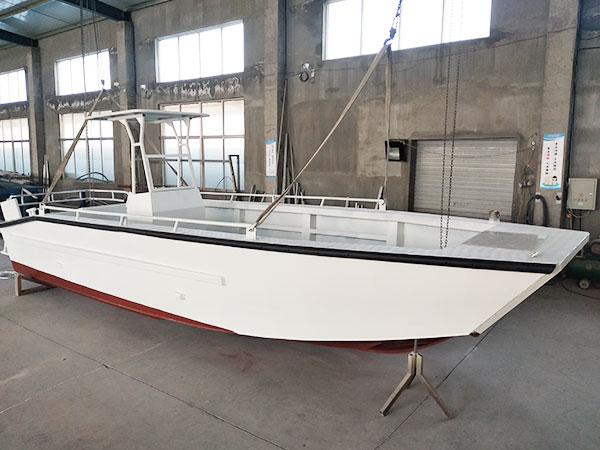
Moving beyond the bare hull, the integrated hardware determines your daily sampling success. Every component must work together seamlessly to ensure crew safety and biological efficiency. You cannot piece together a shock boat from random marine catalogs; the systems must be engineered as a cohesive unit.
The front booms extend the electrical field ahead of the boat, catching fish before the hull spooks them. You must compare fixed, folding, and retractable fiberglass booms. Fiberglass is mandatory because it isolates the high-voltage wiring from the aluminum hull. Fixed booms offer rigid durability but make highway trailering incredibly difficult. Retractable or folding booms slide out of the way during transport and allow you to navigate through tight, overgrown channels without snagging low-hanging branches.
Dropper arrays hang from the ends of the booms and deliver the current into the water. Umbrella designs spread the electrical field widely, making them perfect for shallow-water sampling. Ring designs focus the current deeper into the water column. You choose your array based on target species and water depth. Sampling apex predators like largemouth and smallmouth bass requires different field settings than sampling dense schools of forage fish like bluegill. You tune the arrays for diverse environments. A 1-acre private pond demands a tighter, more controlled field than a large, open public reservoir.
Your generator serves as the beating heart of the entire electrical system. Sizing the built-in generator correctly prevents underperforming in the field. Most professional setups require between 5,000W and 9,000W of continuous power. High-conductivity water demands higher amperage to maintain the field. Low-conductivity water requires significantly higher voltage to push the current through the resistive water column.
The control box translates raw generator power into usable, safe fishing current. Look for precise, digital control over voltage, pulse frequency (Hz), and duty cycle. You must adapt these settings to specific biological sampling needs on the fly. Different fish species respond to different pulse frequencies. Catfish, for example, respond better to low frequencies, while smaller forage fish require higher frequencies. Fine-tuning these parameters maximizes catch rates while minimizing muscle tetany and fish stress.
Water Conductivity Type | Typical Environment | Electrical Requirement Focus | Recommended Generator Size |
|---|---|---|---|
Low Conductivity (Soft Water) | Mountain streams, granite basins | High Voltage (to overcome resistance) | 7,500W - 9,000W+ |
Medium Conductivity | Typical inland lakes, reservoirs | Balanced Voltage and Amperage | 5,000W - 7,500W |
High Conductivity (Hard Water) | Coastal estuaries, mineral-rich rivers | High Amperage (current flows easily) | 5,000W - 6,500W |
Electrofishing carries severe inherent risks. The "Stay Away" rule applies to any vessel lacking mandatory safety integrations. Buyers must absolutely reject boats missing core safety features. Foot-pedal deadman switches located on the bow are non-negotiable. If the netter loses their balance and falls overboard, their foot leaves the pedal, instantly cutting the high-voltage power before they hit the water. This single feature saves lives every season.
Emergency stop buttons at the driver's console give the operator immediate control over the entire system. Heavy-duty safety rails keep the crew securely on deck during sudden impacts with submerged objects. Deck coatings isolate the crew from the electrical field. You must evaluate non-slip, non-conductive deck materials. Marine-grade rubberized liners provide excellent electrical insulation and prevent slipping. Bare aluminum decks pose a severe, unacceptable shock hazard to the crew.
Catching the fish represents only half the job. Keeping them alive and stress-free for analysis completes the mission. You must size oxygen-infused, recirculating livewells correctly. They need to handle large samples of sensitive species without causing overcrowding or oxygen depletion. Rapid water turnover systems remove toxic ammonia and keep dissolved oxygen levels high during hot summer sampling sessions. Many professional boats integrate pure oxygen bottles with micro-pore diffusers directly into the livewell plumbing.
Ergonomic deck layouts speed up the scientific process. Measuring boards, digital scales, and blood sample collection stations need dedicated, secure spaces. A cluttered deck leads to dropped equipment, tripped crew members, and stressed fish. Design the layout to ensure rapid processing, accurate data recording, and immediate release back into the waterway. Built-in storage compartments keep nets, tags, and clipboards out of the walking paths.
Procurement involves balancing competing operational needs. You must carefully weigh customization against logistics, and stability against maneuverability. Every design choice impacts how the boat performs in specific field conditions.
Many buyers initially consider modifying an existing recreational boat to save money. Retrofitting standard aluminum boats with aftermarket electrofishing gear introduces extreme safety risks and structural failures. Standard hulls lack the reinforced decking needed for heavy generators. Their wiring channels cannot safely isolate high-voltage cables from standard 12-volt marine electronics. Running 500 volts next to your outboard's ignition wire is a recipe for catastrophic electrical fires.
Investing in a turnkey, purpose-built Aluminum Electrofishing Boat eliminates these hidden costs and dangerous vulnerabilities. Factory-integrated systems ensure all safety switches, wiring harnesses, and grounding points work flawlessly together from day one. The initial investment secures a vessel designed specifically from the keel up for high-voltage aquatic operations, ensuring decades of safe service.
Hull dimensions dictate exactly where you can sample. Wider, longer hulls provide superior lateral stability for the crew. They offer ample deck space for larger livewells, multiple netters, and extensive analysis stations. A 20-foot boat with an 84-inch beam provides an incredibly stable platform for open-water reservoir work. However, wide boats struggle in tight environments and cannot navigate narrow creeks or heavily wooded swamps.
Narrower hulls excel at navigating tight streams and heavy cover. They slip between submerged trees and navigate narrow, winding river bends easily. The trade-off comes at the expense of deck space and lateral stability. A narrow boat tips more easily when two netters lean over the same side to retrieve a heavy fish. You must analyze your primary sampling environments carefully before finalizing your hull dimensions.
A fully rigged shock boat weighs significantly more than a standard recreational vessel of the same length. You must factor in the dry weight of the thick aluminum hull, the massive built-in generator, heavy deep-cycle batteries, and structural reinforcements. A standard 18-foot bass boat might weigh 1,500 pounds, while an 18-foot electrofishing boat can easily exceed 3,000 pounds dry.
This massive payload requires custom heavy-duty trailers. Standard boat trailers will bend or fail under the concentrated weight of the generator compartment. Safe highway transport demands tandem axles, heavy-duty winches, reinforced bunks, and integrated surge or electric braking systems. Never underestimate the towing logistics and vehicle requirements when planning your procurement. You need a heavy-duty truck capable of pulling and stopping this specialized rig safely.
Owning the right equipment only solves part of the equation. Operating it safely and maintaining strict compliance requires rigorous protocols and ongoing maintenance. High voltage in wet environments leaves zero room for operational errors.
Marine electrical systems fall under strict regulatory scrutiny. You must ensure the vessel meets or exceeds federal and state standards. Agencies like the Department of Wildlife Resources (DWR) and the Louisiana Department of Wildlife and Fisheries (LDWF) maintain rigorous equipment protocols for their fleets. OSHA mandates specific safety redundancies for high-voltage work environments. A purpose-built vessel from a reputable manufacturer will carry the necessary certifications, proper warning labels, and compliance documentation required for agency use. Operating a non-compliant boat exposes your organization to massive liability.
The safest boat on the water still requires a highly trained, alert crew. Hardware safety features cannot replace human awareness. Rigorous crew training remains mandatory before launching. Operators must understand electrical field theory to tune the control boxes correctly for different water conductivities. If the operator sets the frequency too high, they risk injuring the fish; if too low, the fish escape the field.
Every crew member must maintain current CPR certification. Standard Operating Procedures (SOPs) must dictate clear emergency protocols. Teams must practice man-overboard drills, emergency shutdown sequences, and livewell management regularly to ensure muscle memory takes over during a crisis. Communication on deck is vital; the operator and netters must use clear, standardized verbal commands before engaging the power.
Biologists often work miles from the nearest boat ramp or cell phone tower. Equipment failure in remote locations ruins expensive sampling seasons and wastes agency budgets. Establishing strict, uncompromising maintenance schedules prevents downtime.
Change generator oil frequently due to constant high-load operation.
Inspect boom wiring daily for chafing, loose connections, or cracked insulation.
Test all deadman switches and emergency stops before leaving the boat ramp.
Send control boxes in for annual factory calibration to ensure accurate voltage and frequency outputs.
Check hull zinc anodes monthly and replace them when they reach 50% depletion.
Preventative maintenance keeps the vessel operational during critical, time-sensitive biological surveys. A broken wire or a fouled generator carburetor can cost a research team a week of irreplaceable data collection.
An aluminum electrofishing boat stands as a non-negotiable requirement for serious fisheries management. It offers the only viable combination of structural durability, massive payload capacity, and critical electrical safety required for the job. Base your final procurement decision on your primary water conductivity, required draft depth, and target species. Always prioritize manufacturers with a proven, documented track record of integrating redundant safety systems and heavy-duty hull fabrication.
Take the following steps to finalize your procurement process:
Document the specific water conductivity ranges, flow rates, and depth profiles of your primary sampling locations.
Consult with specialized marine manufacturers to request custom quotes based on your required generator size, deck layout, and payload needs.
Request detailed schematics of the vessel's electrical safety redundancies, including deadman switches, isolation transformers, and grounding points.
Develop a comprehensive crew training manual covering electrical field theory, species-specific settings, and emergency shutdown procedures.
A: The effective range of the electrical field typically reaches 6 to 10 feet deep. This depth depends heavily on water conductivity, generator output, and the specific anode array setup. Highly conductive water allows the field to penetrate deeper, while soft water restricts the effective range.
A: Yes, when properly manufactured. Proper grounding, non-conductive rubberized decking, and isolated electrical systems make aluminum highly safe. In many configurations, the massive surface area of the aluminum hull acts as a highly effective cathode, improving the electrical field.
A: Pulsed Direct Current (DC) is the industry standard. It induces galvanotaxis, safely drawing fish toward the anode with minimal harm. Alternating Current (AC) causes severe muscle tetany and is generally avoided by biologists due to significantly higher fish mortality rates.
A: When calibrated correctly by trained biologists, electrofishing does not harm the population. The electrical field only temporarily stuns the fish for safe netting and data collection. Once placed in an aerated livewell, fish typically recover fully within minutes and are released unharmed.
A: Biologists use the boat's deck as a mobile laboratory. Common analyses include measuring overall length and weight, collecting blood samples for health monitoring, inserting tracking tags, and assessing the general population dynamics of the waterway.
A: Absolutely. While frequently used on large public reservoirs and rivers, properly sized shock boats are highly effective for private management. They help biologists sample 1-acre to 5-acre private ponds to manage species like largemouth bass and bluegill effectively.
A: Most professional setups require between 5,000 and 9,000 watts of continuous power. The exact size depends on your control box specifications and the water conductivity of your primary sampling environments. Soft water generally requires larger generators to push higher voltages.


